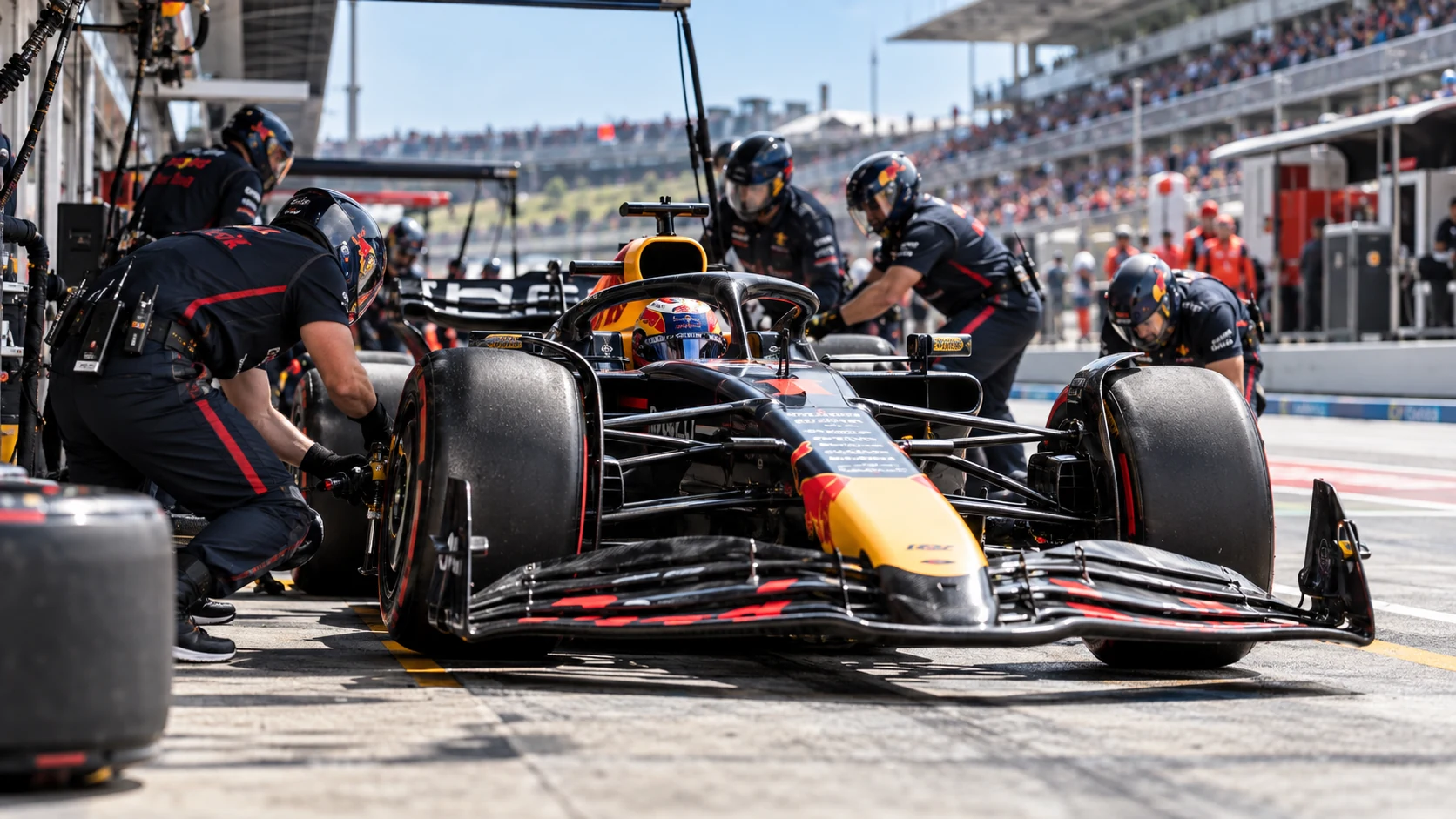
A Formula 1 pit stop compresses a large amount of teamwork into a tiny window. The car arrives at exactly the right position, mechanics lift it, remove and replace the wheels, make any permitted adjustments and release it back into the fast lane. The operation succeeds only when dozens of movements happen in the correct order.
The stop begins before the car reaches the box
The driver receives a call to pit and must slow for the pit lane, find the team’s garage and stop accurately on the marks. A few centimetres can matter because each wheel crew and jack operator is positioned for a predictable car location.
Wheel crews work as mirrored units
At each corner, mechanics are assigned to remove the wheel, operate the wheel gun and fit the replacement. Their motions are practised repeatedly because consistency is more valuable than one spectacularly fast attempt followed by mistakes.
Jacks and release systems have to agree
The front and rear of the car are lifted so all four wheels can be changed. The car cannot be released until the team is satisfied that the work is complete and the path out of the box is safe. A fast stop that sends the driver into another car or with a wheel insecure is not a successful stop.
Why practice matters
Teams rehearse pit stops away from race pressure to build muscle memory. The aim is for every mechanic to recognize normal movement and immediately notice when something feels wrong. Repetition also helps the group recover from small problems without losing the whole sequence.
Pit stops are strategic tools
The stop itself is only one part of the decision. Teams also consider tyre life, gaps to rivals, traffic, weather and the possibility of neutralized racing. A perfectly executed stop can create track position, but stopping at the wrong time can erase the advantage.
That combination of physical precision and strategic timing is why the pit lane remains one of the most intense places in Formula 1.